

Contents
Founder-led businesses are the UK’s most resilient small firms, and if you started yours and still run it, you’re probably weathering the storm better than most.
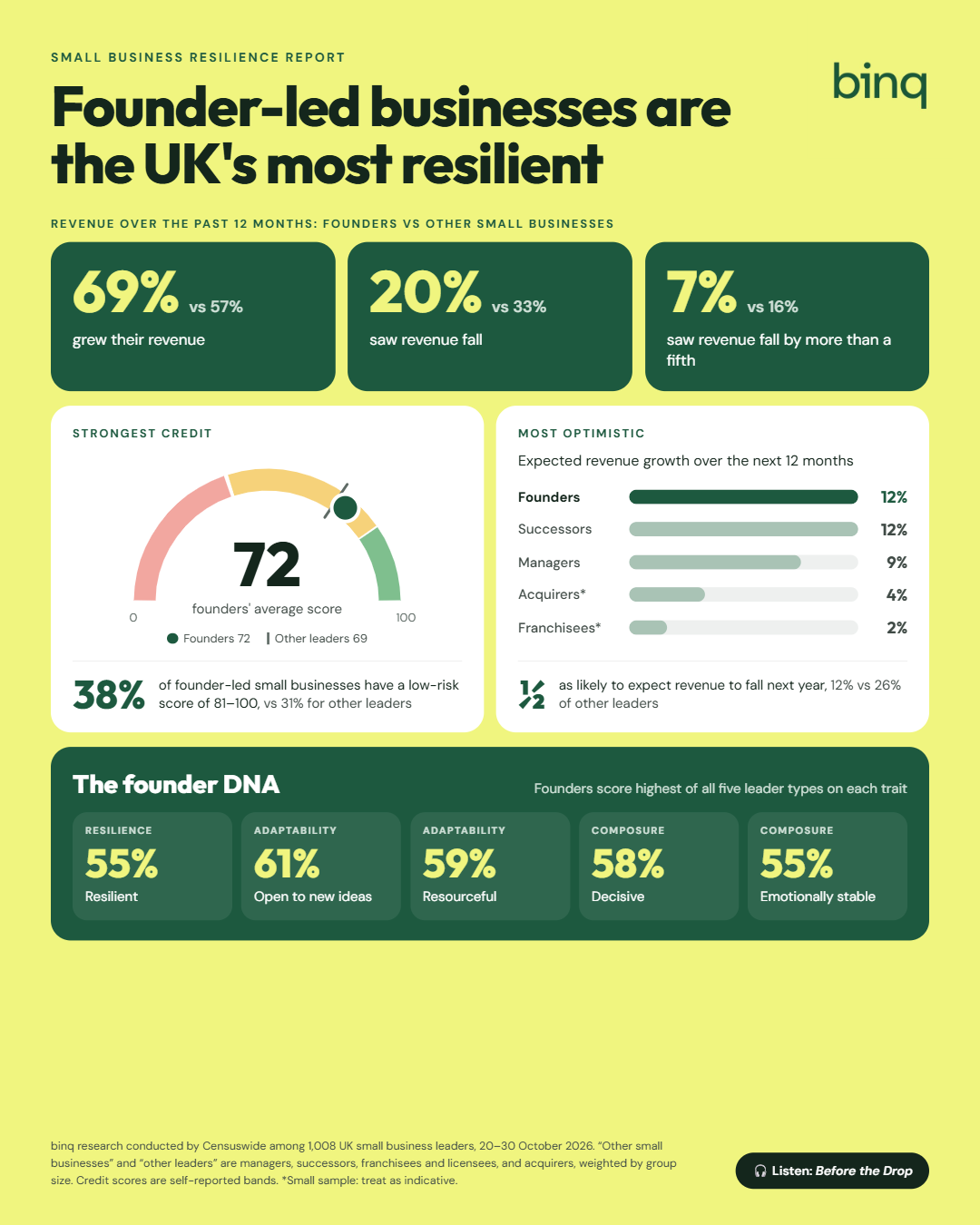
New research from Binq, carried out by Censuswide, found that four in five founder-led small businesses (79%) grew their revenue over the past 12 months. For small businesses with other kinds of leadership, that figure drops to 57%.
We're publishing the findings during Global Entrepreneurship Week, and to mark the launch of Before the Drop, our new podcast for small business owners. Here's what we found, and what it might mean for you.
Founder-led businesses grew faster
We compared small businesses still run by their founder with those led by hired managers, family successors, franchisees or licensees, and investors who have bought an existing business and now run it. On every measure of revenue, founders came out ahead.
Over the last 12 months | Founder-led | Other small businesses |
|---|---|---|
Grew revenue | 79% | 57% |
Average revenue growth | 8% | 5% |
Saw revenue fall | 20% | 33% |
Saw revenue fall by more than a fifth | 7% | 16% |
That last row matters most. A sharp drop in revenue is what pushes many small businesses to the edge, and founder-led firms were less than half as likely to suffer one.
Stronger credit, better borrowing
Founders also report the healthiest credit profiles of any leader type. Nearly four in 10 (38%) say their business has a low-risk credit score of 81 to 100, compared with 31% of other small business leaders. A score in that range usually unlocks the best credit deals and interest rates.
Founders also have the highest average score of any group: 72, versus 69 for other leaders.
The founder DNA: resilient and adaptable
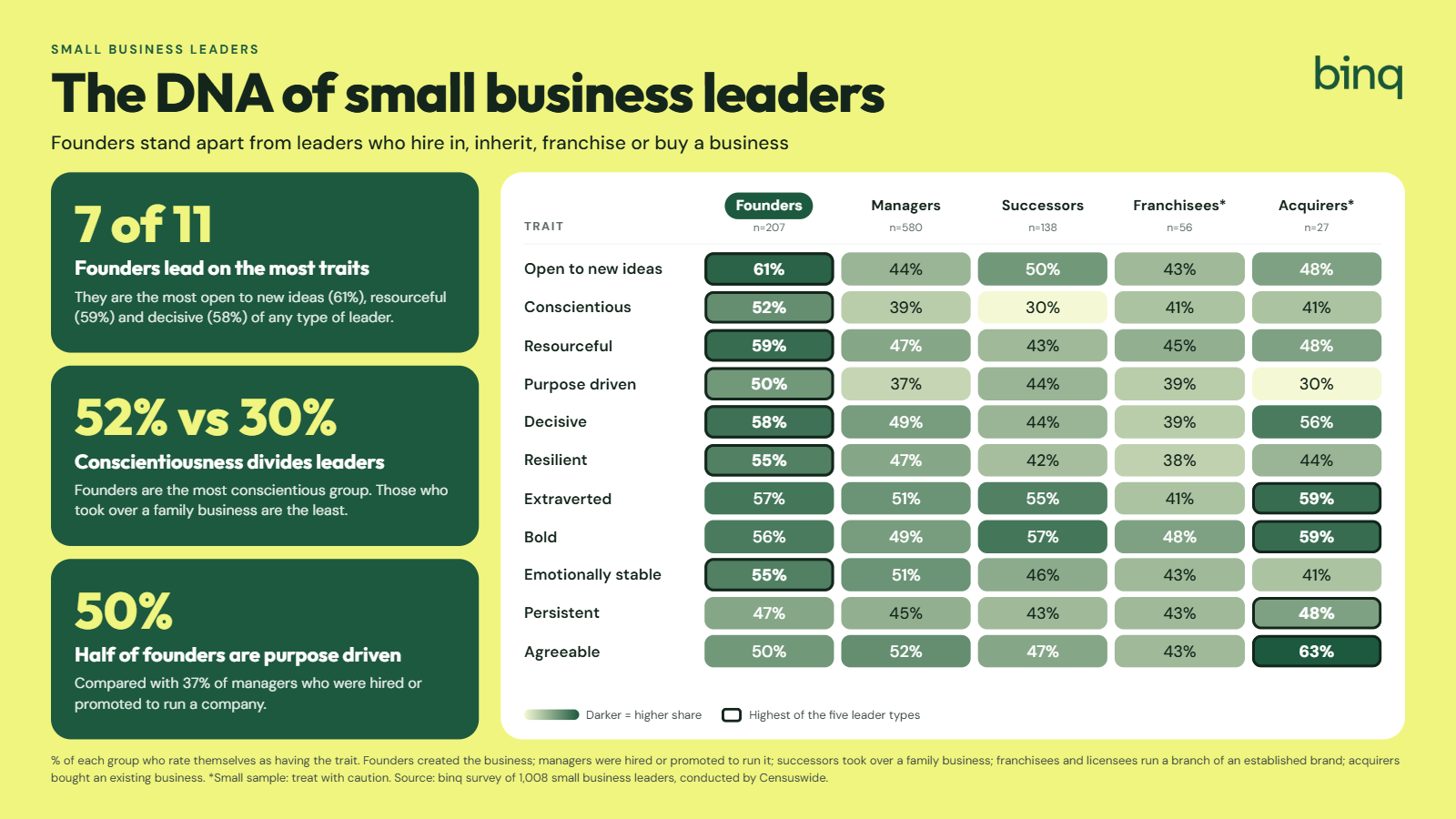
Why do founder-led businesses hold up so well? Our research suggests the answer lies partly in the people running them. Founders were the most likely of any group to show the personality traits that help a business adapt when conditions change.
Resilience. More than half of founders (55%) describe themselves as resilient, compared with 47% of managers, 42% of family successors and 38% of franchisees.
Adaptability. Founders are the most open to new ideas (61%, against 44% of managers) and the most resourceful (59%, against 47% of managers). Those are the traits that let you change course and make the most of what you have when circumstances shift.
Composure under pressure. Founders are also the most likely to call themselves decisive (58%) and emotionally stable (55%). That helps them act quickly without being knocked off balance.
Optimism. Founders expect revenue to grow by 12% over the next year. That's the joint-highest forecast, alongside family successors, and well ahead of managers (9%), acquirers (4%) and franchisees (2%).
In short, the qualities it takes to start a business seem to be the same ones that keep it going when times get tough.
Not a founder? You can still borrow the playbook
You don't need to have started your business to lead it like a founder. The traits in our research are habits as much as personality, and any small business leader can build them.
Stay open to new ideas. Make room to test a new product, price or channel before you need to.
Know your numbers. Resourcefulness starts with seeing clearly what money is coming in, going out and sitting idle.
Decide, then adjust. A quick decision you can revisit often beats a perfect one that comes too late.
Look after your credit. A strong credit score gives you options when an opportunity, or a rough patch, arrives.
Listen: Before the Drop
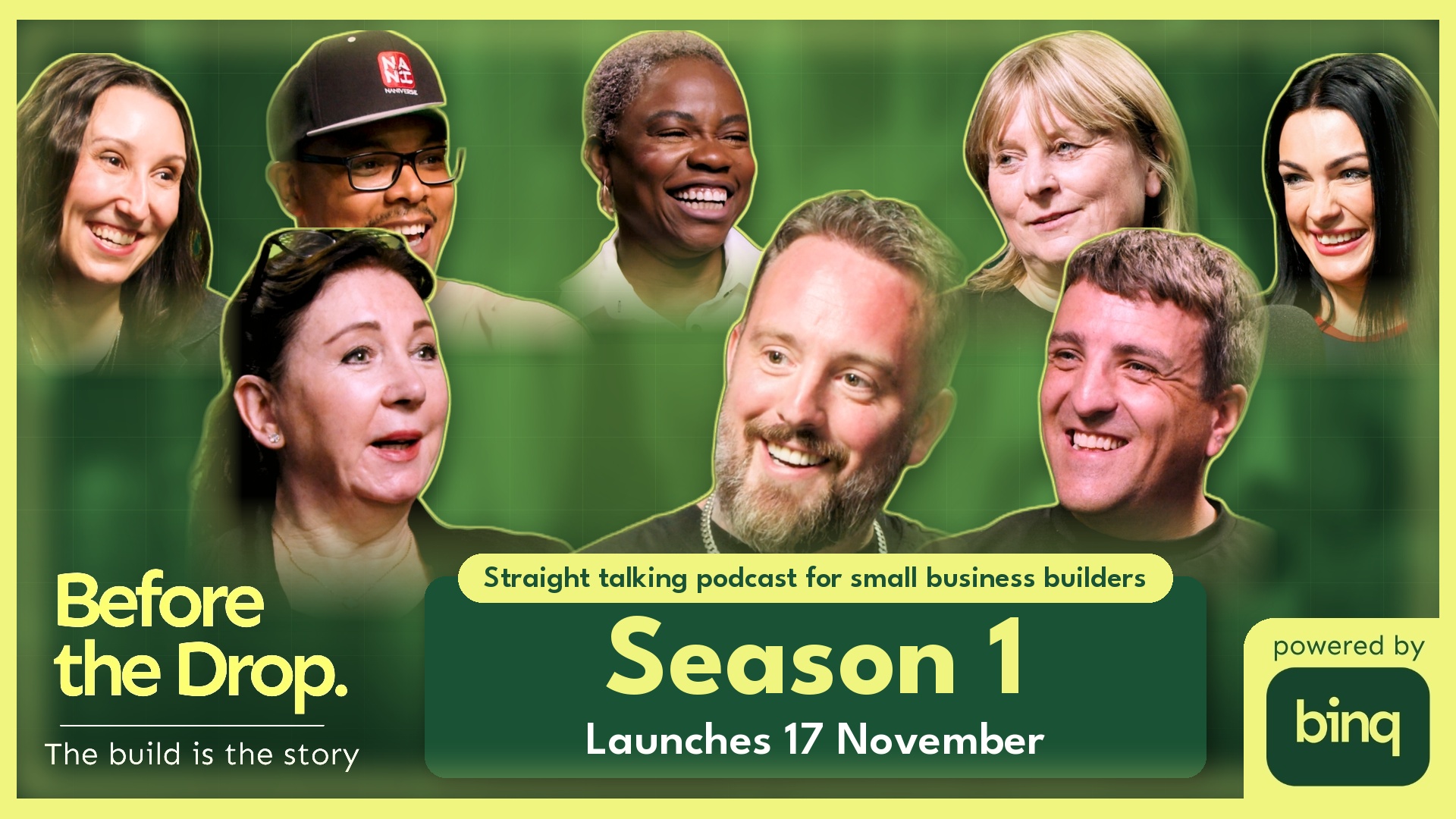
We launched this research alongside Before the Drop, Binq's new podcast for small business owners. Each episode goes behind the scenes with the people building UK businesses: the tough calls, the near misses and what kept them going.
And if you want a clearer view of your own business finances, from cash flow to credit, get started by downloading Binq's business finance app from Apple’s App Store or Google Play.
About the research
The research was conducted by Censuswide among a sample of 1,008 UK small business leaders (aged 18+) between 20 and 30 October 2026. It included questions about each business's credit score, performance and leadership.
Definitions. Founders created the business. Managers are external CEOs or managing directors, or internal executives promoted to run the company. Successors are relatives of the previous leader who took over a family business. Franchisees and licensees own and run a local branch of an established national or international brand. Investors (also called acquirers) are outsiders who bought an existing business and now run it.
Figures. Credit scores are as reported by respondents, who were asked which band their business falls into: 81 to 100 (low risk), 40 to 80 (medium risk) or below 40 (high risk). Revenue figures are self-reported changes over the past 12 months and expected changes over the next 12 months. Personality traits show the percentage of each group who chose the trait over its opposite or neither. "Other small business leaders" is the average of managers, successors, franchisees and licensees, and acquirers, weighted by group size. Findings for franchisees and licensees, and for acquirers, are based on small samples and should be treated as indicative.

James Taylor leads PR and communications for Binq. He brings more than 20 years’ experience in financial services, technology and business-to-business communications, including as Head of PR at Experian, one of the UK’s best-known credit and data businesses.