

Contents
Most small business owners can tell you whether they're profitable. Far fewer can tell you whether their cash flow is genuinely good. The gap between those two things is where businesses stall, struggle, or quietly miss the growth they deserve.
Cash is King (and Queen) for small businesses – so ignore it at your peril!
At Binq, we believe cash flow performance can be measured against three clear benchmarks. Each is achievable on its own. But the businesses that hit all three at once are in rare company: they operate with an elite level of cash efficiency and confidence that most of their peers never reach.
Cash flow best practices for small businesses
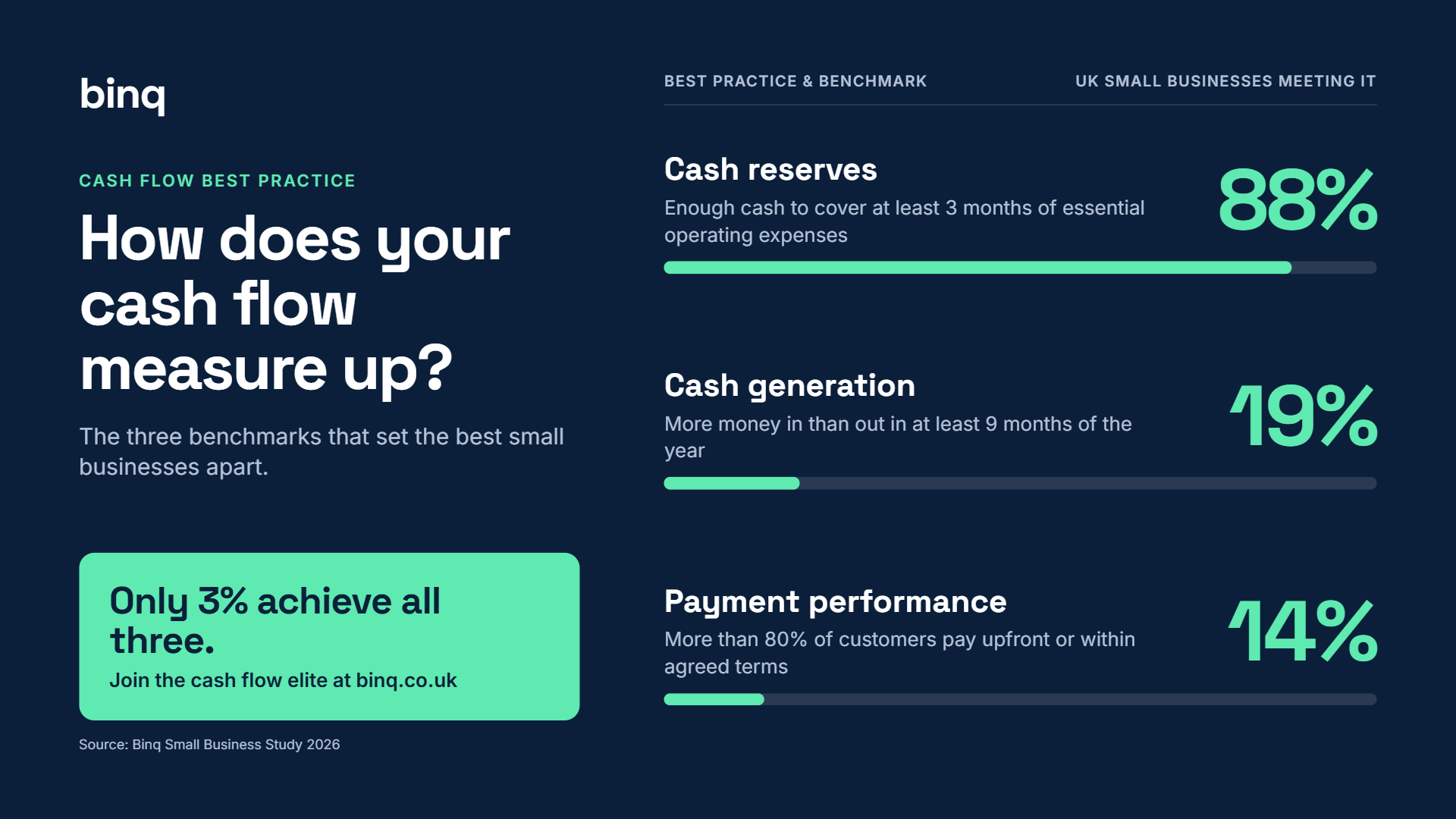
Put them together and the group becomes very exclusive indeed. Binq estimates that just 3% of small businesses, roughly one in thirty, have successfully achieved all three best practices. That's the cash flow elite.
Here's what it takes to join it, and why it's worth the effort.
1. Cash reserves: hold at least 3 months of essential expenses
The benchmark: your business holds enough cash to cover at least three months of essential operating expenses, such as salaries, rent, suppliers and tax.
Why it matters
A cash reserve is your business's shock absorber. A major customer pays late, a key contract ends, energy prices spike, or a tax bill lands bigger than expected. With three months of cover in the bank, these become problems to solve rather than threats to survival.
This isn't just Binq's view. Intuit QuickBooks advises small businesses to keep enough cash on hand to cover three to six months of business expenses (Xero recommends the same safety net).
Reserves also buy you time to think. Businesses without a buffer are forced into reactive decisions: expensive short-term borrowing, delayed supplier payments, or cutting the very investment that would have driven recovery.
The good news, and the catch
This is the benchmark UK small businesses are best at. Binq's research shows that 88% already hold enough cash to cover at least three months of essential expenses, and the average small business holds around six months' worth.
But there's a catch. One in five (18%) small businesses hold nine months or more of essential expenses in cash, which is generally considered too much.
Why too much cash is a problem too
Let's be clear: holding too much cash is far less dangerous than holding too little. A business with excess cash isn't going to fail because of it. But it is paying a hidden price.
Cash sitting idle in a current account loses value every year. Even if inflation sits at the Bank of England's 2% target, £200,000 left untouched would lose around £4,000 of real purchasing power in a single year, and more when inflation runs higher.
The bigger cost is opportunity. Every pound beyond a sensible buffer is a pound that could be hiring a new team member, upgrading equipment, launching a product, paying down debt, or earning a return in a savings or treasury product. Elite cash flow businesses hold enough to be safe and then put the rest to work.
The elite target: three to six months of essential expenses held in reserve, with any surplus deliberately deployed into growth, debt reduction or interest-earning accounts.
2. Cash generation: be cash flow positive for 9 months a year
The benchmark: your business generates more cash than it spends in at least nine months out of every twelve.
Why it matters
Profit tells you whether your business works on paper. Cash generation tells you whether it works in real life. A business can be profitable over a year and still spend months burning through its reserves, because costs land before customers pay, or because income is lumpy and expenses aren't.
Every month of negative cash flow draws down your buffer. String a few together and the reserve you built so carefully starts to shrink, leaving less room for both emergencies and opportunities. Consistent cash generation is what keeps reserves topped up without the owner having to inject money or borrow.
It's also what funds growth. Businesses that reliably generate surplus cash can invest from their own resources, on their own timetable, rather than waiting for a lender's approval or giving up equity. And they can say yes to opportunities. A QuickBooks study found UK small business owners had lost £26,000 on average by turning down work specifically because they lacked the cash flow to take it on.
Nine months, rather than twelve, is a more realistic standard. Almost every business has quiet periods, seasonal dips, or months with big one-off bills. The elite don't avoid those months entirely; they keep them to a minimum and plan for them in advance.
Where most businesses stand
This is where the performance gap opens. Binq's research shows six in ten (61%) small businesses spend more money than they bring in for at least six months of the year. Just one in five (19%) achieve the nine months of positive cash flow a year that experts recommend.
That picture is consistent with independent data. Xero's Crunch report, prepared by Accenture from real inflow and outflow data of thousands of UK small businesses, found that the average firm was cash flow negative for 4.5 months of the year.
Xero described these challenges as persistent and systemic.
The elite target: at least nine cash-positive months a year, backed by a rolling cash flow forecast so that the negative months are expected, planned for and covered by reserves rather than an emergency loan.
3. Payment performance: get over 80% of customers paying on time
The benchmark: more than 80% of your customers pay upfront or within the payment terms you agreed.
Why it matters
A sale isn't really a sale until the money is in your account. Until then, you've potentially delivered the work, paid people to do it, and effectively lent your customer the money. When customers pay promptly and predictably, you can plan with confidence. When they don't, every other part of your cash flow becomes harder to manage.
A real challenge for small businesses
This is the benchmark small businesses find hardest to hit, and it's rarely their fault. Binq's research shows that, on average, just half (50%) of small businesses' customers pay upfront or within agreed terms. That's well short of the 80% best-practice threshold, which only 14% of small firms achieve today.
The UK government recognises the scale of the problem. The Department for Business and Trade says late payments cost the UK economy £11 billion a year and lead to 38 business closures every day. In May 2026 it introduced the Small Business Protections Bill to Parliament, proposing a 60-day cap on large firms' payment terms and mandatory interest on late payments.
The Federation of Small Businesses (FSB), which worked with ministers on the reforms, has said tackling late payment is one of the biggest things government can do to help small businesses grow.
Larger customers are often the culprits. Xero has reported that 55% of large organisations admitted paying their small business suppliers later than agreed in the previous 12 months.
How poor payment performance holds back growth
Late payments don't just cause short-term stress. They quietly change how business owners behave.
When you can't be sure when money will arrive, you naturally become more cautious. Cash that could be invested in a new hire, new equipment or a marketing push gets held back "just in case" a big invoice goes unpaid. That's one reason some businesses end up sitting on more cash than they need: the reserve isn't really a reserve, it's insurance against their own customers.
The elite target: more than 80% of customers paying upfront or on time, supported by clear terms agreed before work starts, prompt invoicing, easy ways to pay, deposits or upfront payment where appropriate, and a consistent (and persistent) process for chasing overdue invoices.
Joining the cash flow elite
Each of these benchmarks is valuable on its own. Together, they're transformative.
A business that holds the right level of reserves, generates cash consistently and gets paid on time has something most small businesses never experience: genuine financial freedom. It can absorb shocks without panic, invest in growth without waiting for permission, and put surplus cash to work instead of letting it quietly lose value in the bank.
The numbers show how rare that is. Most UK small businesses have the safety net in place, but fewer than one in five generate cash consistently and only around one in seven get paid reliably enough. By Binq's estimate, just 3% manage all three at once. That leaves a significant opportunity for the businesses willing to aim higher.
The first step is knowing where you stand. Ask yourself three questions:
Do we hold between three and six months of essential expenses in cash, and is any surplus being put to work?
In how many of the last twelve months did we bring in more than we spent?
What share of our customers paid upfront or on time over the past year?
If you can answer "yes", "nine or more" and "over 80%", congratulations: you're among the 3% of small businesses in the cash flow elite. If not, you now know exactly where to focus. Binq can help you measure your performance against all three benchmarks and take the steps to get there.

James Taylor leads PR and communications for Binq. He brings more than 20 years’ experience in financial services, technology and business-to-business communications, including as Head of PR at Experian, one of the UK’s best-known credit and data businesses.