

Contents
Why is your business credit score important? A strong score is a sign of resilience, that you are less likely to fail and leave customers and suppliers in the lurch. It is a universal measure of your business health, and a stronger one supports access to cheaper loans, better payment terms with suppliers and a faster yes when you need finance.
A weak one means higher rates, extra paperwork, lost contracts, or being turned away altogether. The lower the score, the more likely you are to fail.
A strong credit score can help you win work too. Some customers check a supplier's credit status before awarding contracts, or filter out poor performers at the tender stage, to help ensure that the partners they rely on are financially stable.
Binq offers small businesses visibility of their business credit score in our business finance app, as well as personalised guidance to help improve it.
What is a good business credit score?
A good business credit score is above 80 out of 100, which marks a business as low risk.
Scores above 80 show that you are a low-risk business and among the least likely to fail or suffer serious financial distress . We recently conducted a survey of 1,000 UK small businesses: a third (33%) of them told us they had credit scores of 80+.
A score below 40 suggests you are at a high risk of default or insolvency, and you’ll struggle to get credit as a result. Our study suggests that around 3% of small businesses sit here.
Most small businesses (56%) say they sit within a medium risk middle ground, 41 to 80, where lenders and suppliers will tread with caution. The businesses can face delays accessing finance and are often asked for extra information and personal guarantees when seeking credit.
How to improve your business credit score
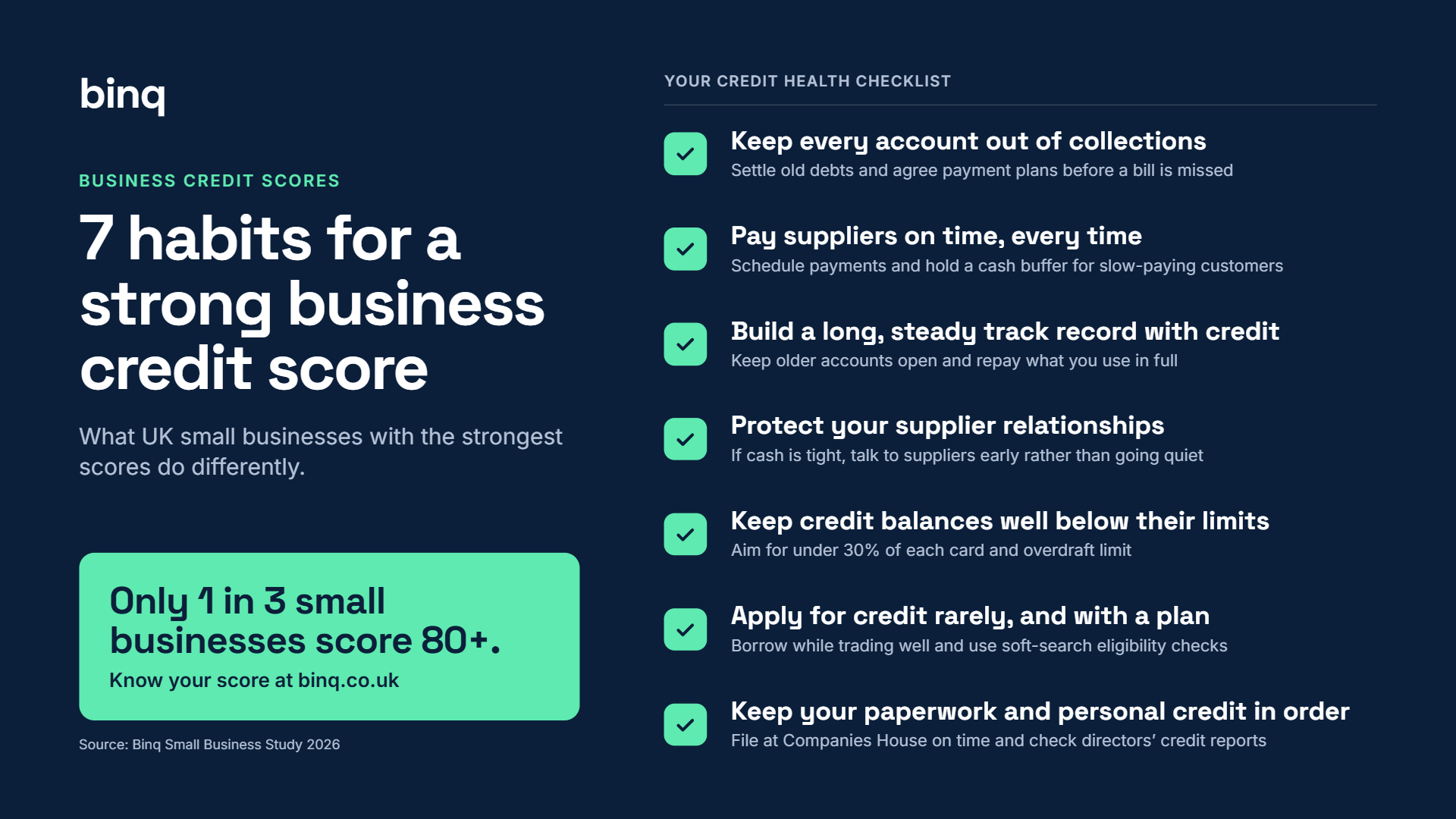
Business credit scores are a robust prediction of risk and can't be “gamed”, but the good news is that those with the best scores aren't doing anything complicated. They stick to a few good habits that any business can copy to improve their financial resilience, reduce their risk of failure and prove they can manage credit responsibly.
To help show what separates the best from the rest, we asked the 1,000 small businesses we surveyed how they handle payments, borrowing and paperwork.
Here are the seven habits that showed up most among the strongest scorers in our survey:
1. Keep every account out of collections
A clean record with no collections or defaults was the single clearest sign of a top-scoring business. 36% of low-risk businesses had never had an account go to collections or default. That fell to 24% of medium-risk businesses and 16% of high-risk ones.
What to do
Put every regular bill on a direct debit or a calendar reminder, so nothing slips by accident.
If you can't pay on time, call the supplier or lender before the due date and agree a payment plan. A plan you keep is far better than a default.
If an old debt has already gone to collections, settle it. A settled record looks much better to lenders than an open one.
The benefit: a default can stay on your business's credit file for six years. Avoiding even one keeps your options open for a long time.
2. Pay suppliers on time, every time
Paying all suppliers on time or early was one of the strongest habits of top scorers. Nearly half (47%) of low-risk businesses said they always pay on time, compared to around a third of medium-risk and high-risk businesses.
Many suppliers share payment data with credit reference agencies like Experian, so paying invoices late can impact your credit report and credit score.
What to do
Pay each invoice on or before the due date, not when you remember. Most accounting software can schedule payments for you.
Keep a cash buffer of at least three months essential expenses, so a slow-paying customer doesn't force you to pay late.
Chase your own customers promptly. Late money coming in is one of the most common reasons money goes out late.
The benefit: a record of on-time payments tells lenders you're reliable, and suppliers are more likely to offer longer payment terms.
3. Build a long, steady track record with credit
Lenders trust what they can see, and a long history of using credit well makes a big difference. 42% of low-risk businesses used several credit products with years of good repayment, compared with 29% of medium-risk businesses.
The flip side was a thin history. 35% of medium-risk businesses had only one line of credit or less than two years of history, against 24% of low-risk businesses. A thin file isn't a bad file, but it gives lenders less to go on, so they ask for more information.
What to do
Keep an older credit account open and in use, even lightly. Its age is part of your history.
Add a second type of credit when it genuinely helps the business, such as a business credit card alongside an overdraft, and clear it in full each month.
Ask suppliers you buy from regularly for trade credit (for example, 30-day terms) and pay it on time. Many report this good behaviour.
The benefit: the longer your record of good repayment, the less paperwork lenders ask for and the better the rates they offer.
4. Protect your supplier relationships
When suppliers lose confidence, it often shows up on your credit file. Among the lowest-scoring businesses, 44% said suppliers had closed or restricted their accounts, or moved them to pay-upfront terms. That compares with 27% of low-risk businesses.
The high-risk group in the survey was small, so treat this as a warning sign rather than a firm rule. But it matches what lenders look for: a supplier cutting your terms suggests others may soon do the same.
What to do
Treat your key suppliers as partners. If cash is tight, tell them early and agree new dates rather than going quiet.
If a supplier has moved you to upfront payment, ask what it would take to restore your terms, then meet that target.
Avoid stretching one supplier to pay another. It tends to spread the problem rather than solve it.
The benefit: keeping trade terms protects your cash flow today and keeps a positive payment record building on your file.
5. Keep credit balances well below their limits
Using most of your available credit, or relying on it to cover day-to-day costs, signals strain to lenders. In the survey, 46% of the lowest-scoring (highest-risk) businesses kept balances above half their limits, compared with 34% of low-risk businesses.
This was a weaker pattern than the habits above, but it lines up with standard lender advice: keep balances below about 30% of your limit.
What to do
Check each card and overdraft once a month. If a balance is above 30% of its limit, plan to bring it down.
Pay down the balance before the statement date where you can, so the lower figure is what gets reported.
Use credit for planned spending, not to cover a regular shortfall. If you dip into the overdraft every month, look at pricing, costs or customer payment terms instead.
The benefit: low balances show you're in control and leave you headroom for an emergency or an opportunity.
6. Apply for credit rarely, and with a plan
Each credit application can leave a mark on your file, and lots of them close together can look like a business under pressure. 41% of low-risk businesses made only occasional, planned applications, compared to 31% of high-risk businesses. Frequent, repeated applications ran the other way: 26% of low-risk businesses, rising to 35% of high-risk ones.
What to do
Plan to borrow ahead. Apply for an overdraft or loan when you're trading well, not when you're already short.
Use eligibility checkers that run a "soft search" before applying (these don't show to other lenders) or work with a specialist broker (like Binq) that can help you approach the lenders most likely to say yes.
If an application is turned down, find out why and fix it before trying elsewhere, rather than applying to several lenders in a row.
The benefit: fewer, better-timed applications keep your file looking calm and give each application a better chance of success.
7. Keep your paperwork and personal credit in order
Public records are some of the first things lenders check, and the tidiest businesses scored better. 51% of low-risk businesses always filed their accounts and confirmation statements at Companies House on time, compared with 41% of medium-risk businesses. Low-risk businesses were also more likely to file accounts showing positive net worth and stable or growing turnover (47% versus 39%).
For small firms, the directors' personal credit matters too. 36% of medium-risk businesses said their directors had minor personal credit issues or a limited history, compared with 28% of low-risk businesses.
What to do
Put your Companies House deadlines in the diary, with a reminder a month ahead, and agree them with your accountant.
Where it's an option, consider filing fuller accounts if they show healthy finances. Abridged accounts give lenders less to go on.
Directors should check their own personal credit reports and correct any errors. You can do this for free with TotallyMoney and CredAbility.
The benefit: on-time filings and clean personal records remove easy reasons for a lender to say no or ask for more.
Your credit health checklist
Start with the first three this month; together they cover the habits most closely linked to a top score:
Set up direct debits or reminders for every regular bill
Contact any supplier or lender you might pay late, before the due date
Settle any debts already in collections
Keep your oldest credit account open and in good standing
Bring card and overdraft balances below 30% of their limits
Plan your next credit application around a strong trading month
Add Companies House deadlines to your diary
Check your business credit report, and each director's personal report, for errors
Credit scores move slowly, so the payoff builds over months rather than days. Each on-time payment and each month without a missed bill adds to a record that lenders and suppliers will reward.
Know the score if you want to get credit!
Please remember that the best actions to improve your business credit score will depend on your precise circumstances, including what your credit report and credit score looks like today.
Binq's cashflow and credit app shows your business credit score and the factors shaping it, so you know which of these habits will make the biggest difference for you. You'll also get personalised guidance on the steps to take next to improve your score. Open the app today to see where you stand.
About the survey: 1,008 UK small businesses took part in October 2026 (including 330 low risk, 568 medium risk, 26 high risk). Percentages are of businesses in each band that answered each question. The results show which habits correlate with stronger scores; they don't prove that any single habit causes a higher score. Figures for the high-risk group come from a small number of businesses and should be read as an early signal.

James Taylor leads PR and communications for Binq. He brings more than 20 years’ experience in financial services, technology and business-to-business communications, including as Head of PR at Experian, one of the UK’s best-known credit and data businesses.